Brilliant Light. Better Understanding.
Laser teeth whitening sounds futuristic. But what does the light actually do? Discover how whitening works, what the research says about LED and laser systems, and why the experience surrounding your smile matters, too.
Is laser whitening the same as LED whitening?
Not exactly. The terms are frequently used together in advertising, but a laser and an LED are different light technologies. Neither should be confused with the whitening ingredient itself.
Focused light technology
Lasers emit light with specific optical properties. Certain dental bleaching techniques have used lasers alongside whitening gels, but clinical evidence does not establish routine superiority over bleaching without light.
Light-emitting diodes
LED systems use semiconductor light sources and are commonly promoted with whitening products. LEDs do not inherently bleach teeth, and their presence does not guarantee a faster or stronger result.
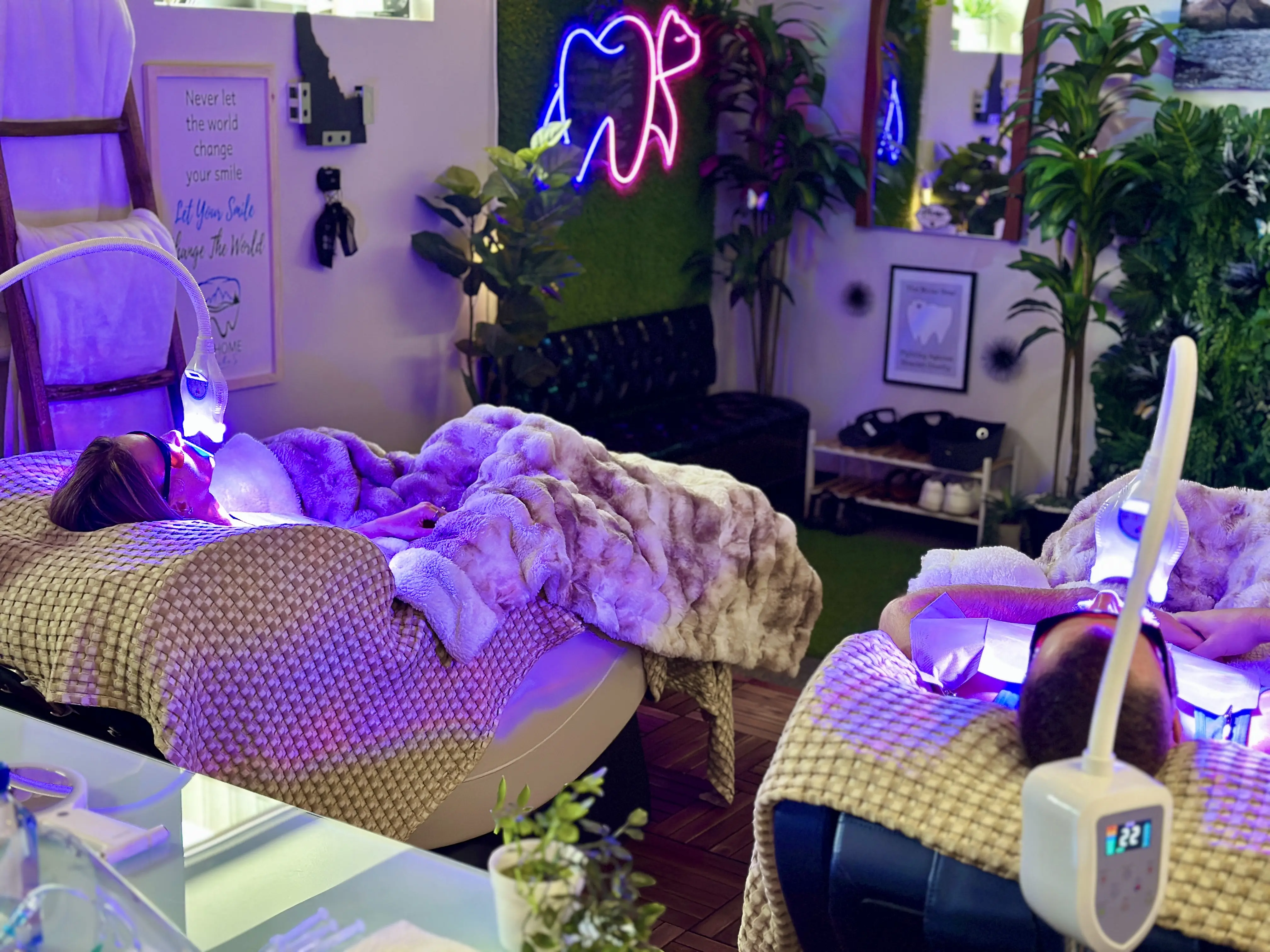
What about IDAHOME Smiles? Our studio incorporates blue and red LED lighting into its whitening environment. We focus our claims on cosmetic whitening and guest comfort—not a promise that light itself produces superior shade changes.
What actually changes tooth color?
Whitening agents interact chemically with certain discoloring compounds in teeth. Whitening outcomes depend on the formulation, treatment conditions, initial shade, and the type of discoloration.
Prepare
Review cosmetic goals and relevant concerns before applying a suitable whitening formulation.
Whiten
Bleaching ingredients act on susceptible discoloration. Some systems include optional light exposure as part of their protocol.
Review
Observe the cosmetic outcome and discuss individual aftercare. Final shade changes vary from person to person.
Remember: Whitening can affect the color of natural teeth, but it does not straighten teeth, reshape them, treat dental disease, or predictably whiten crowns and veneers.
What does the science say about light?
A 2026 umbrella review examined systematic reviews of laser- and light-assisted dental bleaching. Overall, adding light did not consistently improve final whitening efficacy.
The same review found that sensitivity outcomes depend on the technique. Some high-energy protocols raised safety concerns. Research into specific photobiomodulation methods is a separate subject and should not be taken as proof that ordinary LED whitening lights prevent sensitivity.
Can you separate the marketing from the science?
Tap a statement to reveal what current dental research actually supports.
The brighter the LED, the whiter the teeth.
Light brightness alone does not predict whitening results. Evidence has not consistently demonstrated better final results from adding light activation to bleaching protocols.
Whitening gel is an important part of the process.
Peroxide-based whitening ingredients are established bleaching agents. Product formulation, exposure, and individual tooth characteristics help determine the result.
Laser whitening always works faster than strips.
An in-office appointment and an at-home regimen differ in duration and technique. Light activation alone does not guarantee a faster or better result. Comparisons depend on the specific products and treatment schedules.
Whitening is completely sensitivity-free.
Temporary tooth sensitivity and gum irritation are possible with bleaching treatments. Existing or unexplained tooth pain should be evaluated by a dentist before whitening.
A beautiful whitening experience can be relaxing.
The environment is a separate consideration from the chemical whitening effect. Comfortable seating, calm music, and thoughtful guest care can make the appointment feel more enjoyable without claiming improved clinical results.
Educational information only. These explanations do not evaluate individual dental health or guarantee results.
Light-assisted whitening vs. other approaches.
The best comparison starts with what each method is intended to accomplish, rather than assuming a particular technology must be superior.
| Method | Primary mechanism | What to know |
|---|---|---|
| LED or laser-assisted whitening | Bleaching formulation with supplemental light | Light has not consistently improved final bleaching outcomes |
| Peroxide whitening without light | Chemical bleaching of susceptible discoloration | An established approach that does not require light activation |
| At-home whitening strips or trays | Formulation-dependent bleaching over repeated applications | Results, time commitment, and irritation risk vary |
| Whitening toothpaste | Primarily removes external surface stains | Generally does not provide the same shade change as peroxide bleaching |
The light is part of the atmosphere. The experience is the distinction.
At IDAHOME Smiles, our private whitening studio in Historic Downtown Boise brings cosmetic whitening into a setting designed for relaxation.
Step away from the day.
Settle into a zero-gravity massage chair surrounded by ambient lighting, serene music, and an environment designed to help you unwind.
Comfort without exaggerated promises.
We explain cosmetic goals, possible sensitivity, realistic results, and aftercare without promising that a particular light produces an extraordinary outcome.
Looking for a more detailed explanation of sensitivity? Read our guide to tooth sensitivity and whitening .
Good aftercare doesn't need to be complicated.
Maintain regular brushing and flossing, follow the guidance provided at your appointment, and be mindful of frequent exposure to coffee, tea, red wine, and other potential staining sources.
IDAHOME Smiles does not impose a blanket 48-hour white-food diet for every guest. We'll explain the aftercare considerations relevant to your cosmetic session.
Maintain your results
Learn how individual habits influence the appearance of your smile over time.
Explore our maintenance guide →Understand everyday stains
Discover common staining foods and drinks without unnecessary dietary restrictions.
Explore staining foods and drinks →Good questions deserve clear answers.
Is laser teeth whitening better than regular whitening?
Research has not consistently shown that adding laser or LED light produces better final results than comparable bleaching without light.
How does laser teeth whitening work?
Some systems pair a whitening gel with laser light. The bleaching ingredients are central to chemical tooth whitening; the additional light has not consistently demonstrated better final outcomes.
Does LED teeth whitening work without peroxide?
LED light by itself is not an established replacement for a whitening formulation. Peroxide-free products have different mechanisms and varying levels of evidence.
Can whitening cause tooth sensitivity?
Yes. Temporary sensitivity and irritation are possible. Persistent or unexplained dental pain requires professional evaluation.
Will laser whitening damage enamel?
Safety depends on the entire treatment protocol, product, and individual circumstances. Light-based methods are not automatically safer. Excessive energy exposure can raise temperature-related concerns. A dentist should evaluate existing enamel or dental problems.
How long do whitening results last?
Results vary with the initial tooth shade, method, oral hygiene, and staining habits. No exact duration can be guaranteed for everyone.
A brighter-looking smile. A more memorable way to unwind.
Explore our Molar Bear Express, Molar Bear Retreat, and Molar Bear Pair experiences in a private studio designed around relaxation and cosmetic whitening.
Cosmetic whitening only. Results vary. IDAHOME Smiles does not diagnose or treat dental conditions.
Evidence behind the guide.
- Basualdo Allende J, et al. (2026). Do Laser and Light Activation Improve In-Office Dental Bleaching Outcomes? Umbrella review covering efficacy, sensitivity, and safety.
- Maran BM, et al. (2018). In-office dental bleaching with light vs. without light . Systematic review and meta-analysis.
- American Dental Association. Whitening — Oral Health Topics . General bleaching science and possible side effects.
- IDAHOME Smiles. Before & After Care . Studio-specific guidance.
Educational information only. This article does not provide dental diagnosis or treatment advice. IDAHOME Smiles offers cosmetic whitening services.
IDAHOME Smiles · Historic Downtown Boise, Idaho
Fighting Against Enamel Cruelty