There’s a quiet misunderstanding floating around the oral care world right now, and it’s worth clearing up: a lot of people assume nano-hydroxyapatite — nHA for short — is a whitening agent. It isn’t. And here at Idahome Smiles, I’d rather tell you the accurate version than the convenient one, because the accurate version is genuinely more useful.
nHA is one of the most promising ingredients in modern enamel care. But it earns its reputation by doing something different — and arguably more important — than bleaching your teeth. Let me walk you through what it actually does, how it stacks up against fluoride, and where it fits in a real enamel-care routine.
What Nano-Hydroxyapatite Actually Is
Your enamel — the hard outer shell of your teeth — is built almost entirely from a mineral called hydroxyapatite. It’s the same material, structurally, that gives your enamel its strength and its smooth, light-reflecting surface.
Nano-hydroxyapatite is a lab-refined version of that exact mineral, engineered to particle sizes small enough to interact with the microscopic gaps and weak spots that form on enamel over time. Worth saying clearly: nHA is a mineral, not a nutrient. It doesn’t “feed” your teeth. It physically integrates with the enamel surface, filling in and reinforcing the mineral structure that’s already there.
That distinction matters, because it tells you what to actually expect from it.
So Does nHA Whiten Teeth?
Here’s the honest answer: not in the way a whitening gel does.
True whitening — the kind we perform in-studio and the kind a peroxide-based product delivers — works by oxidizing the pigmented compounds inside and on the tooth. That’s a chemical process that lifts stains and changes the shade of the tooth itself.
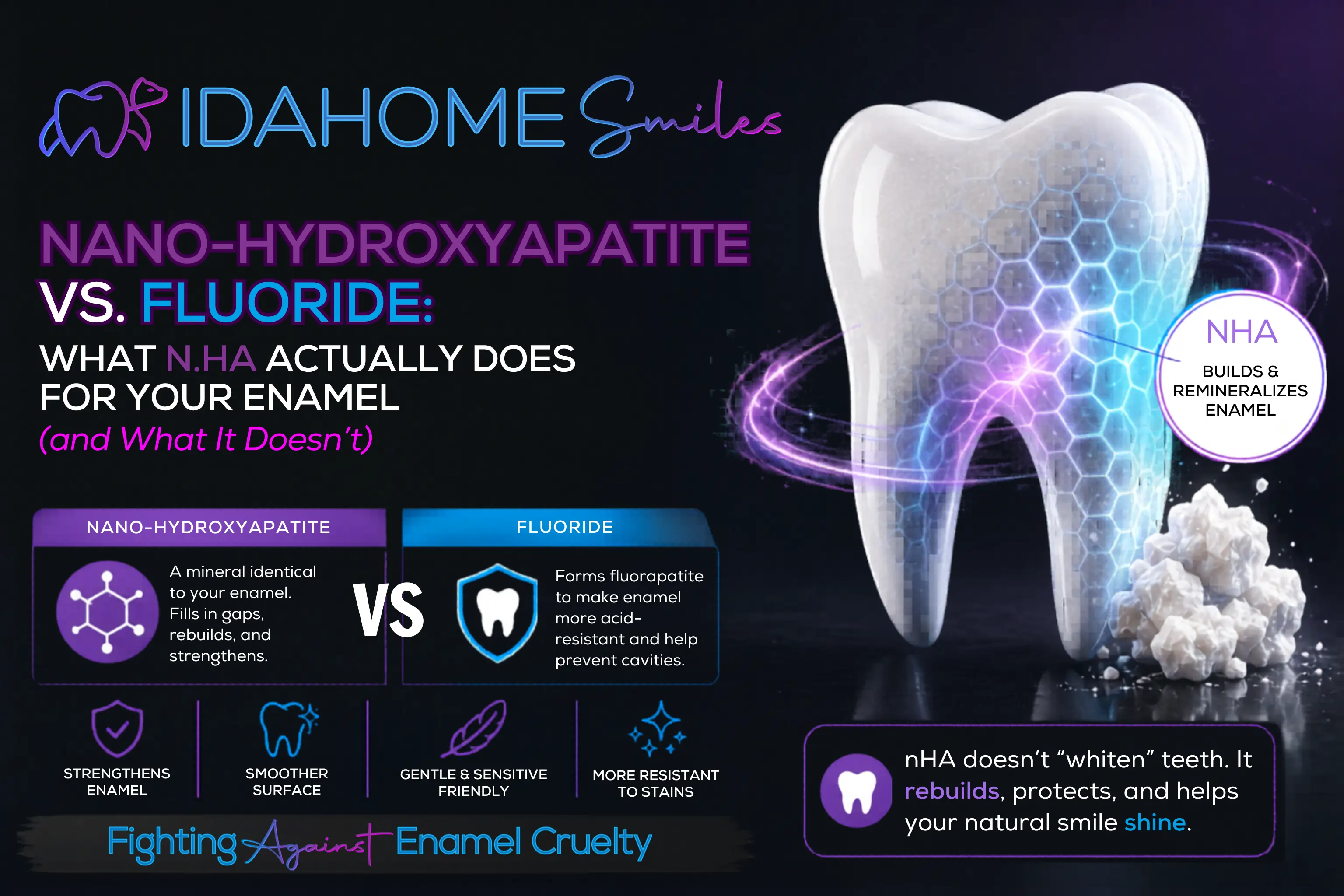
nHA doesn’t do that. What it can do is make your enamel surface smoother and more uniform as it remineralizes. A smoother surface reflects light more evenly, which can make teeth look brighter and cleaner — and a stronger surface is more resistant to picking up new stains in the first place. So you may notice a subtle improvement in appearance over time.
But if your goal is to genuinely change the shade of your teeth, nHA is not the tool for that job. A dedicated whitening treatment is. Anyone telling you a remineralizing toothpaste will take you several shades lighter is overselling it, and you deserve better than that.
nHA vs. Fluoride: Two Tools, Different Jobs
This is the comparison most people are actually trying to make, so let’s be precise about it.
Fluoride works by reacting with your enamel to form fluorapatite — a modified, more acid-resistant version of the enamel surface. It’s well-studied, effective, and the long-standing standard in cavity prevention. Its strength is making enamel tougher against acid attacks.
Nano-hydroxyapatite takes a different route. Instead of altering the surface chemistry, it supplies the same mineral your enamel is already made of, allowing it to integrate directly into worn or demineralized areas. The research here is encouraging: a 2022 randomized clinical trial published in the International Journal of Environmental Research and Public Health compared a biomimetic hydroxyapatite toothpaste head-to-head against a 1450 ppm fluoride toothpaste and found hydroxyapatite effective for remineralizing and desensitizing early enamel lesions. A broader scientific review of hydroxyapatite in oral care reaches similar conclusions about its remineralizing potential. A meaningful advantage for many people is that nHA is fluoride-free and tends to be gentle — which makes it a strong option for those who prefer a non-fluoride routine or who deal with sensitivity.
Neither one is “better” in a vacuum. They’re solving the problem from different angles. The right choice depends on your needs, your sensitivity, and your preferences — and that’s a conversation worth having rather than a one-size-fits-all answer.
Where nHA Fits in a Real Routine
If you take one thing from this post, let it be the framing: whitening changes the color, enamel care protects the foundation. You want both working together, not one pretending to be the other.
A practical sequence looks like this:
- Strengthen first. Consistent use of an nHA-based product helps remineralize the enamel surface and reduce sensitivity, giving you a healthier starting point.
- Whiten with intention. When your enamel is in good shape, a proper whitening treatment delivers cleaner, more comfortable results.
- Maintain the surface. Ongoing remineralization helps your enamel stay smooth and more stain-resistant, which protects the results you paid for.
This is exactly the philosophy behind our approach to enamel remineralization and the way we’ve built kits like the Polar Perfection Kit — care first, results that last.
The Bottom Line
Nano-hydroxyapatite is one of the genuinely exciting developments in enamel care, but it works best when you understand what it’s for. It’s a mineral that helps rebuild and reinforce your enamel — not a shortcut to a whiter shade. Treat it as the foundation, pair it with intentional whitening, and you end up with a smile that’s both brighter and healthier.
If you’re not sure where to start, that’s what we’re here for. Come see us in downtown Boise, or take a look at our before-and-after care guidance to build a routine that actually fits your enamel.
Idahome Smiles — Fighting Against Enamel Cruelty