There’s a quiet misunderstanding floating around the oral care world right now, and it’s worth clearing up: a lot of people assume nano-hydroxyapatite, nHA for short, is a whitening agent. It isn’t. And here at Idahome Smiles, we’d rather tell you the accurate version than the convenient one, because the accurate version is genuinely more useful.
nHA is one of the most talked-about ingredients in modern oral care. But it’s widely misunderstood. Let’s walk through what it actually is, how it differs from fluoride, and how people generally think about where each fits in a routine.
What Nano-Hydroxyapatite Is
Your enamel, the hard outer shell of your teeth, is made largely from a naturally occurring mineral called hydroxyapatite. It’s the same material, structurally, that gives enamel its smooth, light-reflecting surface.
Nano-hydroxyapatite is a lab-refined version of that same mineral, engineered to very small particle sizes. One point worth keeping straight: nHA is a mineral, not a nutrient. It doesn’t “feed” your teeth. In oral care products it’s valued for being gentle and for being a fluoride-free option, which is part of why it shows up in toothpastes and other everyday products.
So Does nHA Whiten Teeth?
Here’s the honest answer: not the way a whitening gel does.
True whitening, the kind we perform in-studio and the kind a peroxide-based product delivers, works by oxidizing the pigmented compounds on and within the tooth. That’s what changes the actual shade.
nHA doesn’t do that. Where it tends to matter cosmetically is on the surface: a smoother, more uniform enamel surface reflects light more evenly, so teeth can read as brighter and cleaner. It won’t change the underlying shade of your teeth the way a dedicated whitening treatment can. Anyone telling you a nano-hydroxyapatite toothpaste will take you several shades lighter is overselling it, and you deserve better than that.
nHA vs. Fluoride: How They Differ
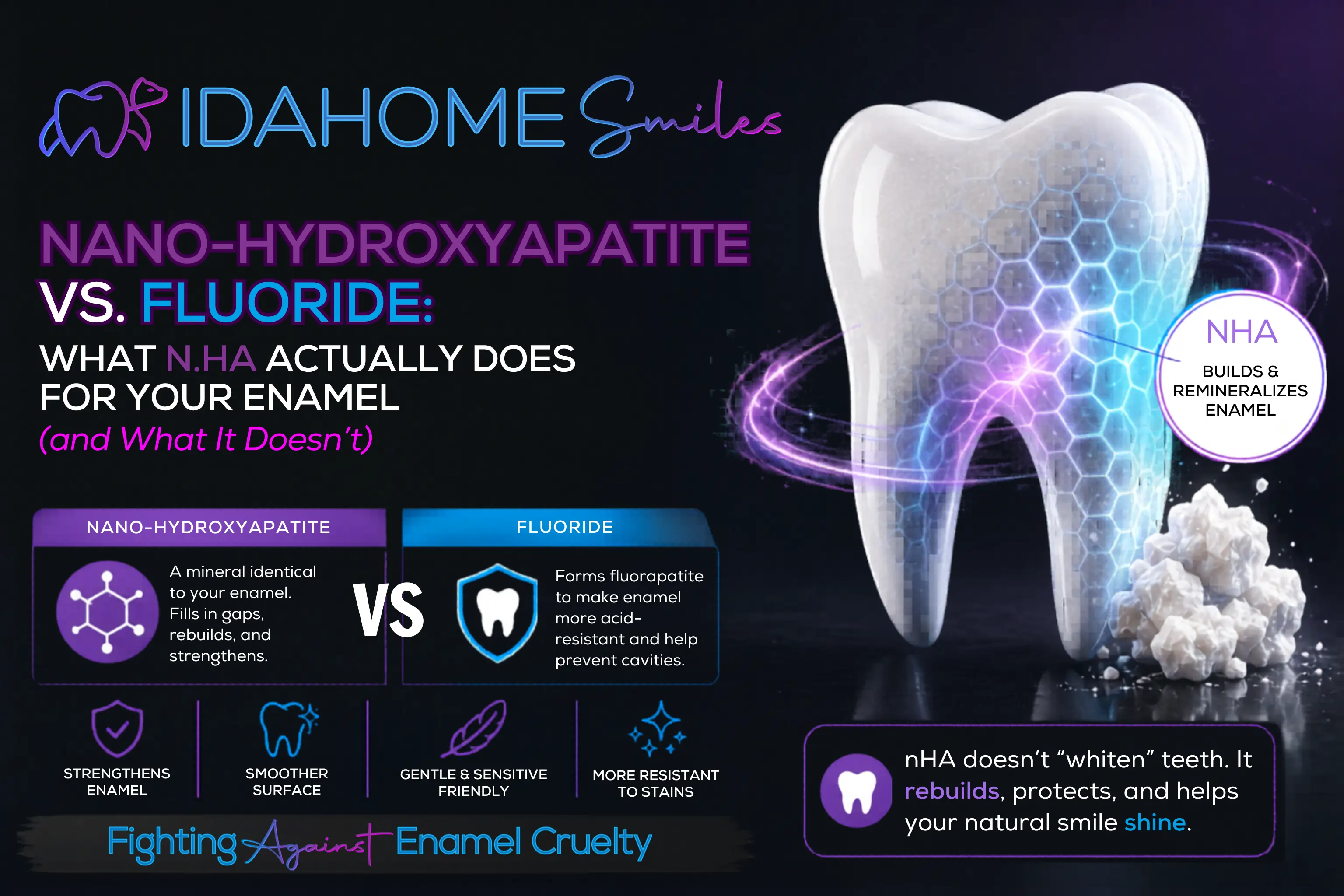
(Image caption: Nano-hydroxyapatite and fluoride are different ingredients with different roles in oral care. Alt text: Comparison of nano-hydroxyapatite and fluoride in oral care.)
This is the comparison most people are actually trying to make, so let’s be precise.
Fluoride is the long-standing, extensively studied standard in cavity prevention. It works by reacting with the enamel surface to form fluorapatite, a more acid-resistant compound. It’s well understood and recommended by dental professionals worldwide. Note that fluoride toothpastes are regulated as over-the-counter drugs precisely because of what they’re formulated to do.
Nano-hydroxyapatite takes a different approach. Rather than changing the surface chemistry, it’s based on the same mineral enamel is already made of. It’s a fluoride-free ingredient that many people choose for its gentleness, particularly those who prefer to avoid fluoride.
What does the science say? Nano-hydroxyapatite has been studied widely as an oral care ingredient. For example, a 2022 randomized clinical trial in the International Journal of Environmental Research and Public Health examined a hydroxyapatite toothpaste alongside a 1450 ppm fluoride toothpaste, and a broader scientific review of hydroxyapatite in oral care surveys the research base. These are general, published findings about the ingredient. They are not claims about results that any particular product, ours or anyone’s, will produce for you.
Neither ingredient is universally “better.” They work differently, and the right choice depends on your needs, your preferences, and guidance from your dental professional. That’s a conversation worth having rather than a one-size-fits-all answer.
Where Each Fits in a Routine
If you take one thing from this post, let it be the framing: whitening changes how your teeth look in terms of shade, while everyday oral care ingredients like fluoride and nHA play their own distinct roles. They aren’t substitutes for one another.
For specifics on which ingredients and products are right for you, your dentist or hygienist is the best source. What we focus on at Idahome Smiles is the professional whitening experience, and how to keep your results looking their best afterward.
The Bottom Line
Nano-hydroxyapatite is one of the more interesting ingredients in oral care today, but it’s widely misunderstood. It’s a mineral that works on the surface and the look of your teeth, not a shortcut to a whiter shade, and not a replacement for the guidance of a dental professional on cavity prevention.
If a brighter smile is your goal, that’s where we come in. Come see us in historic downtown Boise, or take a look at our services and before-and-after care guidance to find the right fit for you.
Idahome Smiles, Fighting Against Enamel Cruelty